Legal Working Hours During Ramadan in UAE
The UAE's primary private sector labour legislation — Federal Decree-Law No. 33 of 2021 — mandates a specific reduction in working hours during the Holy Month of Ramadan. Article 17 states that working hours shall be reduced by two hours per day during Ramadan, bringing the standard 8-hour working day down to 6 hours per day and the weekly limit from 48 hours to 36 hours per week.
This is not an administrative guideline or a cultural practice — it is a legally enforceable entitlement. Employers who fail to reduce working hours during Ramadan are in breach of UAE Labour Law and can be reported to MOHRE. The inspection and complaints process is active during Ramadan, with MOHRE known to increase workplace inspections during the Holy Month.
The starting date of Ramadan is determined by the official moon sighting announcement from the UAE government. Employers should monitor announcements from the UAE Cabinet and the Crescent Moon Sighting Committee, as the start date can shift by a day depending on the moon sighting. AITIME allows the Ramadan Mode start date to be set as soon as the official announcement is made.
| Period | Daily Hours | Weekly Hours |
|---|---|---|
| Regular working year | 8 hours | 48 hours |
| Holy Month of Ramadan (UAE) | 6 hours | 36 hours |
| Saudi Arabia (Muslim employees) | 6 hours | 36 hours |
| Qatar | 6 hours | 36 hours |
| Bahrain / Kuwait / Oman | 6 hours | 36 hours |
Who the Ramadan Hour Reduction Applies To
A common question among UAE HR managers is whether the Ramadan working hour reduction applies only to Muslim employees or to the entire workforce. The UAE Labour Law text does not limit the reduction to Muslim employees — it applies to all private sector employees subject to Federal Decree-Law No. 33 of 2021.
In practice, most UAE employers apply the Ramadan schedule universally across their workforce. This is both the safer compliance approach and the more practical operational choice — maintaining two different shift schedules for Muslim and non-Muslim employees in the same team creates attendance management complexity and potential discrimination claims.
Some employers in sectors where operational continuity is critical (hospitals, emergency services, utilities) maintain standard hours for certain roles with compensatory arrangements. These must be documented and, ideally, discussed with employees prior to Ramadan.
Overtime During Ramadan — Rates and Calculation
During Ramadan, the 6-hour working day becomes the contractual baseline. Any work beyond 6 hours per day during Ramadan is classified as overtime under Article 19 of Federal Decree-Law No. 33 of 2021 and must be compensated accordingly.
The overtime rates during Ramadan are the same as at any other time of year: 125% of the hourly basic rate for regular overtime, and 150% for work between 9 PM and 4 AM. However, the hourly rate base changes slightly during Ramadan for the purpose of calculating overtime pay. Some UAE employers use the standard annual hourly rate (monthly basic ÷ 30 ÷ 8), while others recalculate based on the Ramadan day (monthly basic ÷ 30 ÷ 6). The MOHRE standard is to use the contracted shift as the basis — during Ramadan, that is 6 hours per day.
AITIME handles this automatically — when Ramadan Mode is active, the system uses the 6-hour baseline for overtime threshold detection and applies the correct overtime multiplier to all excess hours.
Ramadan Hours Across Saudi Arabia, Qatar, and GCC
For businesses operating across multiple GCC countries, Ramadan compliance is consistent in principle but varies in application details. Every GCC country reduces working hours during Ramadan for employees subject to local labour law. Saudi Arabia's Labour Law (Article 98) applies the 6-hour day specifically to Muslim employees. Qatar's Labour Law (Law No. 14 of 2004, Article 73) and Kuwait's Labour Law similarly mandate reduced hours.
AITIME supports multi-country GCC operations with country-specific Ramadan rules built in. When Ramadan Mode is activated for a Saudi operation, the system applies the Saudi-specific rules. UAE and Qatar operations can run simultaneously with appropriate configurations for each entity.
Employer Compliance Checklist for Ramadan
- Monitor the UAE government moon sighting announcement and confirm Ramadan start date
- Activate Ramadan working hours on the confirmed start date — not the day before or after
- Adjust all employee shift schedules to reflect the 6-hour working day limit
- Recalculate overtime thresholds — hours beyond 6 per day are now overtime, not just beyond 8
- Ensure payroll software applies the correct Ramadan hourly rates for overtime pay
- Update attendance reports to reflect Ramadan-adjusted hours for MOHRE audit purposes
- Communicate schedule changes to all employees and department managers before Ramadan begins
- Revert to standard hours immediately after the UAE government confirms Eid Al Fitr
Key Facts — Ramadan Working Hours (UAE Labour Law)
- Legal basis: Federal Decree-Law No. 33 of 2021, Article 17
- Reduction: 2 hours per day during Ramadan for all employees
- Standard becomes: 6 hrs/day or 36 hrs/week during Ramadan
- Applies to: All private sector employees (Muslim and non-Muslim)
- Overtime during Ramadan: Hours beyond 6/day = overtime at 125% (or 150% night)
- GCC coverage: Saudi Arabia, Qatar, Kuwait, Bahrain, Oman all have similar rules
- AITIME feature: One-click "Ramadan Mode" adjusts all shifts to 6 hrs automatically
How AITIME Handles Ramadan Automatically
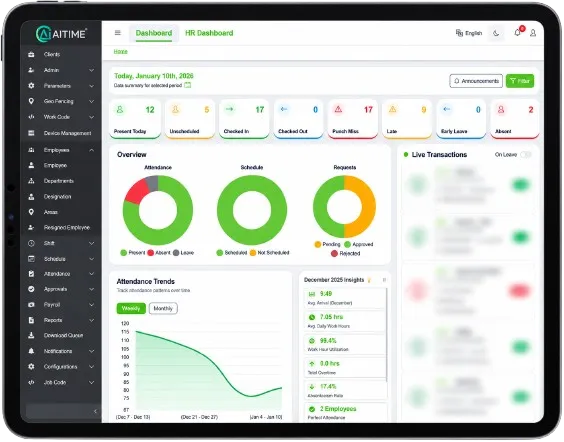
Managing Ramadan hours manually across 50, 200, or 1,000 employees is a significant HR burden that creates compliance risk. Every employee's shift must be adjusted, every overtime threshold recalculated, and payroll must reflect the new daily baseline — all within hours of the official Ramadan start announcement. AITIME removes this entirely with a purpose-built Ramadan Mode.
Activate Ramadan Mode
One toggle in the AITIME admin dashboard activates Ramadan hours across your entire workforce. Set the start date when the UAE government announces it — AITIME applies the change from that date forward automatically.
Automatic shift adjustment
All employee shifts are automatically reduced to 6 hours per day. No manual schedule editing is required across any department, site, or employee category.
Overtime recalculated from new baseline
Any hours worked beyond 6 per day are automatically flagged and calculated as overtime at the correct UAE rate. Biometric check-out records beyond the 6-hour mark trigger the overtime calculation in real time.
Payroll includes Ramadan overtime accurately
All Ramadan overtime is included in the monthly payroll calculation and the WPS SIF file export automatically — no separate data entry or manual adjustments needed.
Revert after Eid
When you deactivate Ramadan Mode after the Eid Al Fitr announcement, all shifts return to their standard configurations immediately. Historical attendance records retain the Ramadan schedule for audit accuracy.