Six countries in one login
UAE, Saudi, Qatari, Omani, Bahraini and Kuwaiti entities each keep their own weekend, holiday calendar, currency and payroll format, while group HR compares headcount, absence and overtime across the whole region.
Free demoFree demo for teams across the UAE, GCC & Africa · Book now
GCC · UAE, Saudi Arabia, Qatar, Oman, Bahrain, Kuwait
AITIME is attendance software for GCC employers with teams in more than one Gulf state. One account applies each country's working hours, Ramadan timetable, summer midday ban and wage protection rules, from Dubai to Dammam to Doha.
Get a quote for the GCC
Share your headcount and sites. A specialist replies with a demo slot and pricing.
In short
AITIME is attendance software for GCC employers. It collects biometric punches from ZKTeco, Hikvision and Dahua terminals plus GPS mobile check-ins, then applies each country's labour law to overtime, Ramadan hours and summer work bans. It exports a UAE WPS SIF file, Mudad-ready Saudi payroll data and payroll inputs for Qatar, Oman, Bahrain and Kuwait. It suits multi-country groups.
Last reviewed 3 November 2026 · AITIME implementation team
Overview
Ask an HR manager at a Gulf group how attendance works and you usually get a list. ZKTeco terminals and a WPS file in Dubai, a separate tool for Mudad in Riyadh, a spreadsheet for the Doha branch, and an accountant in Muscat who types hours into payroll. Every state has its own weekend, Ramadan timetable and wage protection file, so the search for attendance software for the GCC often ends with four tools that never agree.
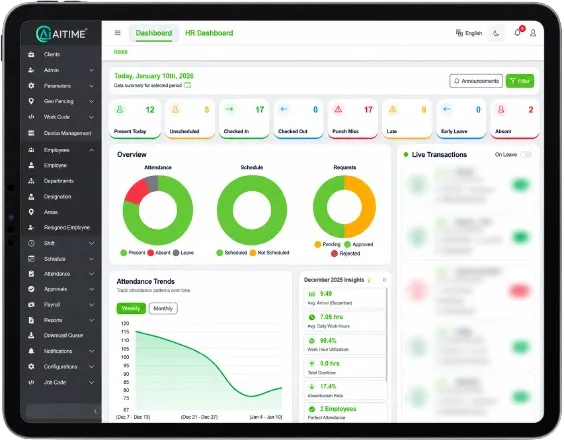
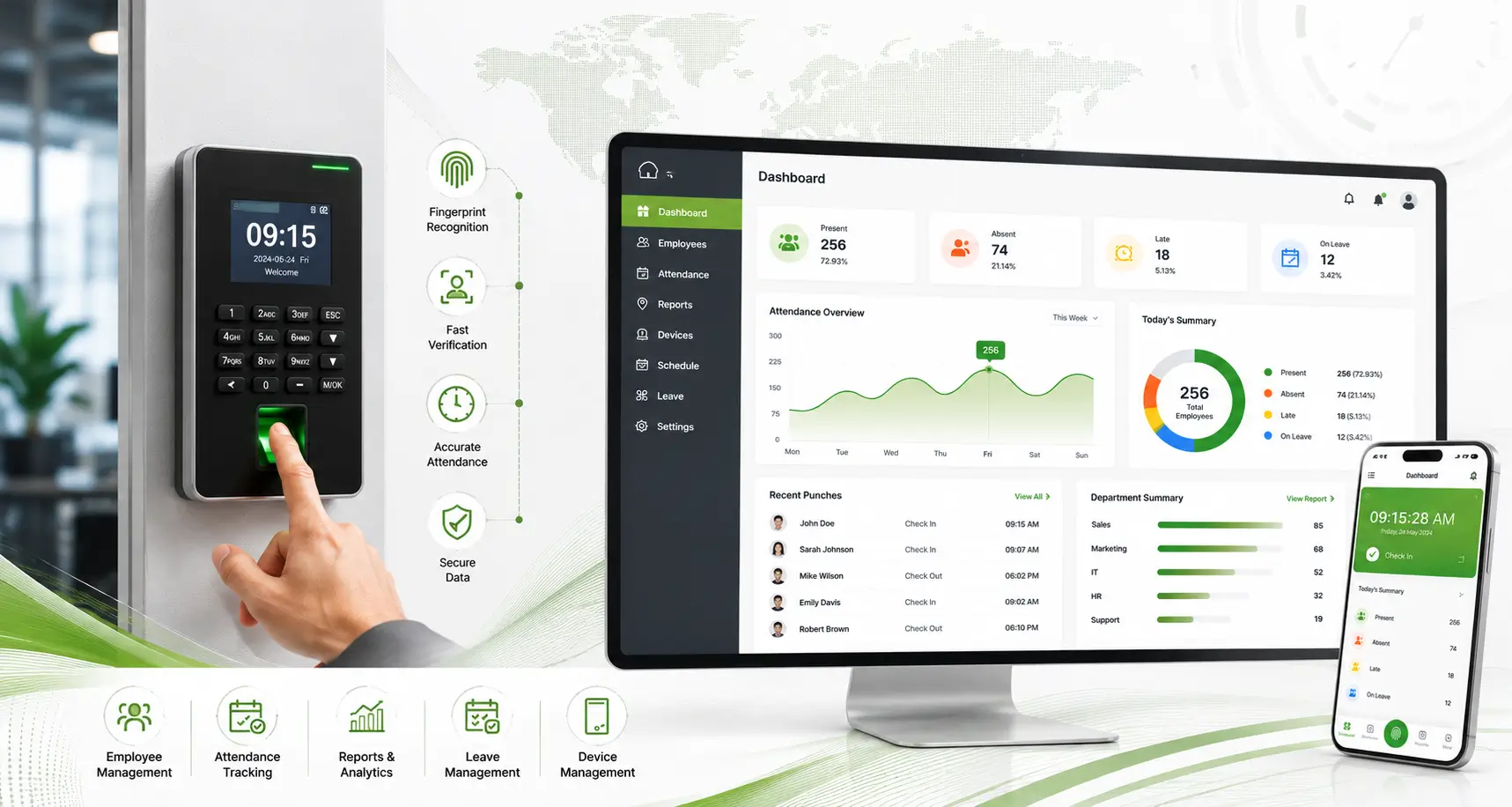
AITIME puts every employee in every Gulf entity on one attendance record. Biometric terminals at offices, warehouses, labour accommodation and project sites feed the same platform as the GPS mobile app used by drivers and field technicians. Each legal entity keeps its own policies, holiday calendar, currency and payroll format, while group HR sees headcount, absence and overtime for the region on one dashboard.
The rules differ more than most people expect. Saudi Arabia, Qatar and Bahrain cap Ramadan days at six hours, while the UAE takes two hours off the normal day. Summer outdoor bans start on different dates and cover different hours in each state. Wages move through the UAE WPS, Saudi Mudad and bank-based WPS schemes in Qatar, Oman and Bahrain, and Kuwait requires salaries to reach local bank accounts.
Rollout usually starts with the country that causes the most month-end pain, often the UAE or Saudi Arabia. We connect existing terminals, import employees and run one payroll cycle in parallel. UAE sites can have on-site installation from our Dubai team. For the other five countries, setup, training and support are delivered remotely by WhatsApp, phone and video, and on-site visits can be discussed during the demo.
Features
UAE, Saudi, Qatari, Omani, Bahraini and Kuwaiti entities each keep their own weekend, holiday calendar, currency and payroll format, while group HR compares headcount, absence and overtime across the whole region.
Generate the UAE WPS Salary Information File and Mudad-ready salary data for Saudi Arabia straight from approved hours. Entities in Qatar, Oman, Bahrain and Kuwait get payroll exports their bank or payroll provider can import.
Switch on Ramadan hours per country: two hours off the UAE day, six-hour days in Saudi Arabia, Qatar and Bahrain, and the reduced timetables your Oman and Kuwait entities follow. Islamic holidays follow the Hijri calendar.
Outdoor crews are rostered around each state's own midday ban, such as 12:30pm to 3pm in the UAE, 12pm to 3pm in Saudi Arabia, 10am to 3:30pm in Qatar and 11am to 4pm in Kuwait.
Track Emiratisation, Saudization and Omanisation headcount by entity, department and grade, so HR can check where each company stands against Nafis or Nitaqat targets using data already in the system.
Connect ZKTeco, Hikvision and Dahua fingerprint and face terminals at offices, labour camps and project sites in every Gulf state. Existing devices can usually be reused, and punches are held offline when the connection drops.
Compliance
Every GCC state writes its own labour law, and the differences show up in timesheets: weekly limits, Ramadan cuts, overtime premiums and summer bans. AITIME keeps a rule set for each country, so a group can apply the right one to each entity automatically.
The UAE, Saudi Arabia, Qatar, Bahrain and Kuwait set a normal limit of 8 hours a day and 48 a week. Oman's Labour Law (Royal Decree 53/2023) sets 9 hours a day and 45 a week. AITIME measures overtime against the right threshold for each entity, not a single group rule.
UAE law requires at least 25% extra, or 50% between 10pm and 4am. Saudi overtime is the hourly wage plus 50% of the basic hourly wage. Qatar, Bahrain and Kuwait start at 25%, with higher rates for night, rest-day or holiday work. Each rate is configured per country.
Saudi Arabia, Qatar and Bahrain limit Ramadan working days to six hours, with Saudi and Bahraini law applying the cap to Muslim workers. The UAE cuts the normal day by two hours, Kuwait caps the week at 36 hours and Oman reduces hours for Muslim workers.
The UAE bans outdoor work from 12:30pm to 3pm between 15 June and 15 September, and Saudi Arabia from 12pm to 3pm over the same period. Qatar restricts 10am to 3:30pm from 1 June to 15 September, and Kuwait 11am to 4pm from June to August. Oman and Bahrain publish their own windows.
Salaries go through electronic wage protection across the region: WPS in the UAE, Qatar, Oman and Bahrain, Mudad in Saudi Arabia, and local bank transfer under PAM oversight in Kuwait. Late or short payments can lead to fines and suspended government services, so hours must be final before the file goes out.
Biometric and location data fall under national privacy laws, including the UAE PDPL (Federal Decree-Law 45/2021), Saudi Arabia's PDPL enforced by SDAIA since September 2024, Qatar's Law 13 of 2016, Oman's Royal Decree 6/2022 and Bahrain's Law 30 of 2018. Role-based access and audit trails support each one.
Industries
Camp and site terminals, crews that move between countries, and outdoor rosters that respect each state's summer ban.
ExploreRotation patterns such as 28/28 for fields and plants in Saudi Arabia, Qatar, Oman and Kuwait, with offline capture at remote locations.
ExploreSplit shifts and 24/7 rosters for groups operating in several Gulf cities, including iftar and suhoor peaks during Ramadan.
ExploreStore teams in malls across the region on one dashboard, with weekend patterns that differ between the UAE and its neighbours.
ExploreGuards, cleaners and technicians posted at client sites in several countries, with GPS proof of attendance per contract.
ExploreWarehouses near Jebel Ali, Dammam's King Abdulaziz Port and Qatar's Hamad Port, plus mobile check-in for drivers on cross-border routes.
ExploreTell us how many people you employ, where they work and which devices you already own. We will map the rules, devices and payroll output before you commit.
Coverage
AITIME runs in all six GCC states, including mainland, free zone and industrial areas:
Pages for the GCC
يقدّم AITIME برنامجاً واحداً للحضور والانصراف للشركات العاملة في الإمارات والسعودية وقطر وعُمان والبحرين والكويت. يجمع النظام تسجيلات البصمة والتعرّف على الوجه من أجهزة ZKTeco وHikvision وDahua وتسجيلات تطبيق الجوال في سجل موحّد، ويطبّق قواعد ساعات العمل والعمل الإضافي وساعات رمضان وحظر العمل وقت الظهيرة لكل دولة على حدة. كما يُصدر ملف نظام حماية الأجور (WPS) في الإمارات وبيانات رواتب جاهزة لمنصة مُدد في السعودية. اطلب عرضاً تجريبياً مجانياً بالعربية أو الإنجليزية.
FAQs · the GCC
Cannot see your question? Message us and a specialist will answer the same day.
Ask on WhatsAppIt depends on how many employees and legal entities you have, how many sites and terminals are involved, and which modules you need, such as payroll exports or the mobile app. Groups that already own compatible ZKTeco or Hikvision devices avoid most hardware spend. Send us your headcount per country and we will prepare a written quote for the whole group.
Yes. Each legal entity is set up with its own country rules, weekend, public holidays, currency and payroll export. Group HR and finance see consolidated dashboards, while local managers only see their own teams through role-based access. If you are comparing HR software for the GCC, AITIME covers the attendance, leave and payroll-input side across all six states.
For the UAE, AITIME generates a WPS Salary Information File from approved hours, overtime and deductions. For Saudi Arabia it prepares Mudad-ready payroll data and tracks GOSI details. In Qatar, Oman, Bahrain and Kuwait it exports payroll inputs as Excel, CSV or through the API, in a format your bank, payroll provider or accounting system can import.
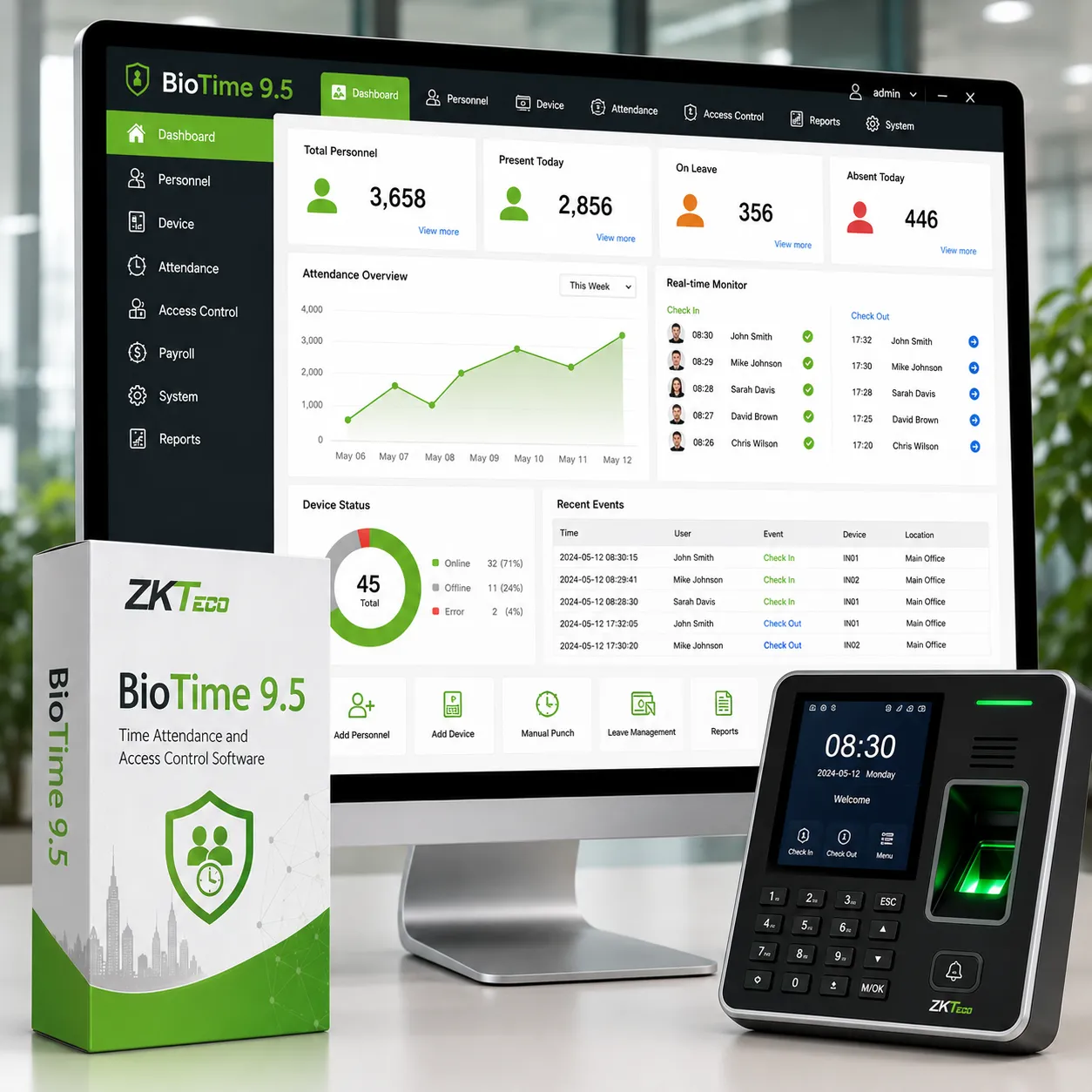
AITIME connects to most ZKTeco models, including those managed in BioTime or ZKBio CVSecurity, as well as Hikvision and Dahua face terminals and AITime devices. Fingerprint, face and RFID card verification are all supported. During the demo we review the models you already run in each country and confirm which can stay.
Ramadan mode is switched on per country, so a Saudi entity moves to six-hour days for Muslim staff while a UAE entity drops two hours from its normal day. Eid and other Islamic holidays follow the Hijri calendar and moon-sighting announcements, and each country keeps its own public holiday list.
Terminals store punches in their own memory and the mobile app records check-ins without signal. Both sync with the original timestamps once a connection returns, so remote oil, construction or utility sites do not leave gaps in payroll. Supervisors can still review attendance from the dashboard once records arrive.
Yes. AITIME reports nationals and expatriates by entity, department and grade, so HR can follow Emiratisation, Saudization and Omanisation headcount alongside attendance. It does not submit data to Nafis, Nitaqat or other government portals, but it gives you consistent figures to check against them.
A single office with existing devices can go live in about a day. Multi-country groups are usually phased: one country first with a parallel payroll run, then the rest. UAE sites can have on-site installation from Dubai, while the other states are set up, trained and supported remotely, with on-site work discussed during the demo.
Free demo & quote
A 20 minute live walkthrough using your own shift patterns and sites, followed by a written quote. No obligation.