Salalah employers plan around a calendar the rest of Oman does not share. From late June the Khareef monsoon turns the Dhofar hills green and brings a surge of GCC visitors, so hotels, restaurants, tour operators and retailers add temporary staff and longer opening hours for about three months. Meanwhile the Port of Salalah and the Salalah Free Zone run around the clock all year, and farms and fishing harbours work by season and weather. Generic attendance software in Salalah struggles with that pattern, and seasonal staff often end up managed on paper.
AITIME lets you build Khareef rosters in advance, add seasonal employees with fixed contract dates and archive them cleanly when the season ends. Port and free zone teams run on 24/7 shift patterns in the same account, while farm workers and fishing crews in Taqah or Mirbat check in from the mobile app, offline if needed.
Everything is calculated under Omani Labour Law: the 9-hour day and 45-hour week, day and night overtime rates, Ramadan hours for Muslim employees and annual leave balances. Seasonal staff accrue leave from their real start and end dates, which avoids disputes when contracts finish in September. Night work at the port is split into day and night overtime automatically, and Omani and expatriate headcount stays visible per entity for Omanisation tracking.
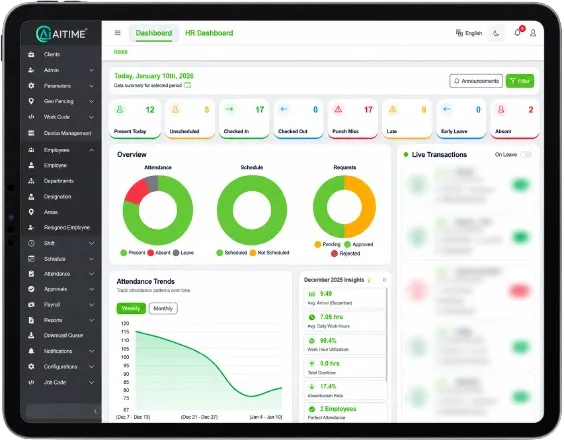
Many Salalah sites report to a head office in Muscat, roughly 1,000 km away by road. The real-time dashboard gives Muscat HR the same view as the local manager. Training and configuration are delivered remotely over WhatsApp, phone and video, and an on-site visit for installation can be discussed during the demo.